Incorporating a company in Bahrain isn’t just about starting a business. It’s about creating a legally recognized entity that complies with the Kingdom’s Commercial Companies Law. This guide explains the legal structures available, the Sijilat workflow, banking and notarization requirements. At LevantBMS, we specialize in handling these legal and regulatory steps so you can focus on your operations. If you’re searching for how to incorporate a company in Bahrain, you’re already looking in the right place. At LevantBMS, we help founders and investors take the right steps to incorporate and grow their businesses in Bahrain with confidence.
At a Glance: Company Incorporation in Bahrain
- Average timeline: approximately 2 to 3 weeks for a standard WLL. Regulated companies that need Central Bank of Bahrain approval take a minimum of three months.
- Typical government fees: Commercial Registration is BD 196 for up to three activities, plus BD 100 for each additional activity, and notarisation is BD 100. Professional fees vary by scope and are quoted per case.
- Foreign ownership rules: up to 100% in most activities; some regulated or strategic sectors require a local partner or extra approval.
- Required approvals: MOIC name and activity clearance, sector regulator sign-off where applicable, and Commercial Registration (CR)
- Post-registration obligations: corporate bank account, employee and investor visas, annual CR renewal, and ongoing tax and compliance filings.
Why Bahrain Is Becoming a Preferred Business Destination in the GCC
Investors comparing Bahrain with other GCC business destinations consistently cite the same structural advantages, many of which are actively promoted by the Bahrain Economic Development Board (EDB) as part of the country’s strategy to attract foreign direct investment (FDI).
- 100% foreign ownership: Available across several hundred approved commercial activities, with no local sponsor required in most sectors.
- Strategic GCC location: Direct causeway access to Saudi Arabia and short flight times to the rest of the Gulf.
- Low operating costs: Office rent, utilities, and staffing costs are generally lower than in Dubai, Abu Dhabi, or Riyadh.
- Tax advantages: no personal income tax, and 0% corporate income tax for most businesses, while oil and gas companies pay 46% on net profits. VAT is charged at 10%, and a 15% Domestic Minimum Top-up Tax applies only to very large multinational groups from 2025.
- Skilled workforce: A bilingual, well-educated labor pool supported by workforce development programs such as Tamkeen.
- Financial services ecosystem: One of the Gulf’s oldest banking centers, regulated by the Central Bank of Bahrain (CBB) for licensed financial activities.
- Digital economy initiatives: A fully digital Sijilat Portal for registration, alongside a growing FinTech and e-commerce licensing framework.
Key Takeaways
Bahrain competes on cost, ownership freedom, and speed of registration rather than market size alone, which is why it tends to suit founders prioritizing a fast, low-cost, 100%-owned GCC base over immediate access to a very large domestic consumer market.
How to Register a Company in Bahrain: Quick Recap
Before the detailed sections below, here is the process in brief: choose an activity and structure, clear your trade name with MOIC, notarize your constitutional documents, file through Sijilat, receive your Commercial Registration (CR), then open a bank account and process visas.
Requirements to Incorporate a Company in Bahrain
Core documents (typical):
The checklist we ask clients to prepare is:
- Power of Attorney or Apostilled Authorisation signed by all partners, authorising your service provider to represent them before the Ministry of Industry and Commerce and other government authorities in Bahrain.
- Copies of the passport and identification documents of all proposed shareholders.
- Share capital amount in BD (required later).
- Proposed shareholding structure where there is more than one shareholder (percentage of each partner).
- Three proposed company names in order of preference.
- Details of the proposed business activities of the company.
- An email account.
- A telephone number.
Please note: a residential address is not required.
- Passport copies for shareholders and directors
- Proposed trade name(s)
- Business activities list (aligned with Bahrain activity taxonomy)
- Articles/Memorandum of Association (drafted to local law)
- Bahrain address/lease (after name/activity pre-clearance)
- Board resolution/POA (for corporate shareholders)
Regulatory checkpoints:
- Commercial Registration (CR): Your CR is legal proof of registration with MOIC and is mandatory before operations. Think of it as your company’s ID.
- Licensing: Some activities require additional approvals from sector authorities (e.g., health, education, and financial services).
- Bank account: Each company must have a corporate bank account
LevantBMS advantage: We validate activities and name availability in Sijilat, draft compliant constitutive documents, and pre-coordinate with banks to shorten onboarding times.
Documents Required for Different Business Structures
The core list above applies broadly, but the exact documents needed depend on whether you are registering as an individual, a foreign company, or a corporate shareholder.
For Individual Investors
- Passport
- Address proof
- Business plan
For Foreign Companies
- Parent company certificate
- Board Resolution
- Memorandum
- Articles
For Corporate Shareholders
- Certificate of Incorporation
- Shareholder documents
- Company profile
Types of Companies You Can Incorporate in Bahrain
| Entity Type | Ownership | Capital | Liability | Best For |
| WLL (LLC) | 1 to 50 shareholders, 100% foreign allowed | (≥ BD 50/share) | Limited | SMEs, consultancy, trading |
| BSC (Closed/Public) | Public/private shareholders | Higher (BD 250k 1m+) | Limited | Large firms, IPOs, joint ventures |
| Branch | 100% foreign-owned | No capital | Parent liable | Multinational expansions |
| Partnership | 2+ partners | No minimum | Unlimited | Professional/legal services |
Which should you choose?
“Choosing the right structure depends on ownership goals, capital plans, and regulatory scope. LevantBMS evaluates your case and recommends the optimal route.”
Types of Businesses That Can Be Registered in Bahrain
Beyond the legal structures above, Bahrain business registration covers a wide range of practical activity categories. Common examples include:
- Trading company: Import, export, and wholesale/retail distribution of goods.
- Consultancy: Management, HR, marketing, or strategy advisory services.
- IT business: Software development, IT support, and technology consulting.
- Construction company: Building, contracting, and civil engineering works.
- Manufacturing: Light and heavy industrial production, often based in designated industrial areas.
- Restaurant: Food and beverage outlets, subject to municipal and health approvals.
- E-commerce business: Online retail and digital marketplaces, supported by Bahrain’s e-commerce licensing framework.
- Holding company: Entities that hold shares in other companies or assets rather than trading directly.
- Professional services: Legal, accounting, engineering, and other licensed professional practices.
- Financial services: Banking, insurance, and investment activities regulated by the Central Bank of Bahrain (CBB).
Mainland vs Free Zone Company in Bahrain
A comparison of Free Zone vs. Mainland Bahrain options is one of the most useful things to understand before you commit to a structure, since it shapes where you can trade and how ownership works.
| Feature | Mainland | Free Zone |
| Ownership | Up to 100% foreign ownership in most activities under current rules | 100% foreign ownership as standard, with no local partner required |
| Office requirement | Physical office or shop generally required, matched to license type | Flexible options, including shared desks or virtual offices |
| Business activities | Broad range, including retail, hospitality, consultancy, and services for local clients | Focused on trading, logistics, manufacturing, and export-oriented services |
| Local market access | Full access to the domestic Bahraini market and government contracts | Generally export-focused, local trading usually requires a distributor or mainland branch |
| Tax | Standard Bahraini tax regime, which remains low by international standards | Additional incentives in some zones, such as customs duty exemptions |
| Best for | Businesses serving Bahraini or GCC clients directly, including consultancy and professional services | Manufacturing, logistics, and trading businesses focused on international markets |
Bahrain’s main free zones include the Bahrain International Investment Park (BIIP) and the Bahrain Logistics Zone, both positioned for manufacturing, logistics, and trade rather than local retail or professional services. For most consultancy, trading, and professional service businesses covered by this guide, a mainland WLL registered through MOIC remains the standard route.
Common Mistakes During Company Registration
- Choosing the wrong legal structure for the intended ownership and growth plans.
- Selecting an incorrect business activity, which can delay approvals or require a costly amendment later.
- Missing required sector-specific approvals before filing through Sijilat.
- Not fully understanding licensing requirements for regulated activities.
- Submitting poor or incomplete documentation, notarization, or translations.
- Ignoring visa planning until after the CR is issued, which can delay operations.
- Underestimating setup costs, particularly office, licensing, and banking-related expenses.
Sijilat Workflow for Incorporation
Instead of repeating Registration steps, keep it legal:
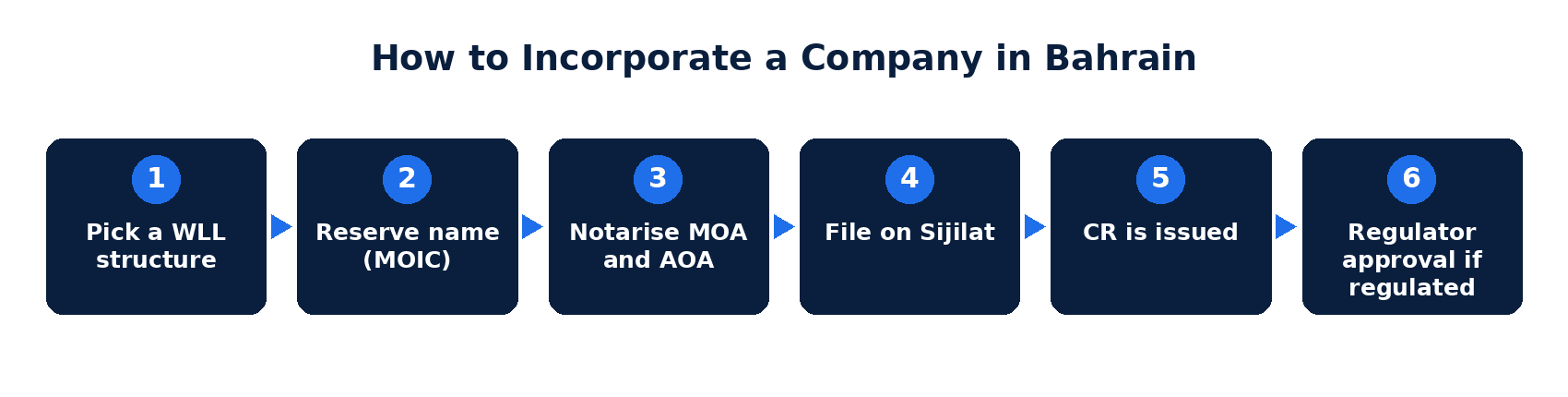
- Reserve trade name (Arabic + English).
- Match activities to MOIC’s taxonomy (and pre-clear regulated ones).
- Draft and notarize MOA/AOA in line with Commercial Companies Law.
- Upload documents to Sijilat → pay fees.
- Receive CR (your company’s legal ID).
- Obtain regulator approvals (CBB, MOH, etc., if applicable).
How to incorporate a company in Bahrain
Costs and Timelines to Incorporate a Company in Bahrain
- Government fees: Depend on entity type, activity count, and required licenses.
- Document costs: Notarization, legalization (if corporate shareholders), and translations where applicable.
- Advisory and processing: LevantBMS provides a fixed, transparent proposal once we validate your scope.
Typical timeline: approximately 2 to 3 weeks for a straightforward WLL, plus bank onboarding time which varies by bank. Regulated activities take a minimum of three months because of external approvals, such as those from the Central Bank of Bahrain.
Cost Breakdown of Company Incorporation in Bahrain
To make the Bahrain company registration process easier to budget for, the table below breaks typical costs into their main components.
The overall cost of establishing a company in Bahrain depends on the nature of the proposed business activity and its licensing requirements. Activities that require additional approvals, regulatory clearances, or multiple licences will generally involve higher establishment costs. A detailed quotation should therefore include all government fees, licensing and regulatory charges, third party expenses, and the professional fees payable to the service provider.
Government fees at a glance:
| Item | Amount |
| Commercial Registration (CR) government fee | BD 196 for up to 3 activities, plus BD 100 for each additional activity |
| Notarisation | BD 100 |
| Annual CR renewal | From BD 166, depending on the share capital (which also affects the Chamber of Commerce fee) |
| LMRA work permit | BD 205 per person per year, renewable for one or two years |
How Long Does Company Registration Actually Take?
Day 1: Choose Activity → Day 2: Reserve Company Name → Day 3 to 5: Submit Documents → Government Review → License Approval → Commercial Registration → Business Begins
- Day 1: Choose your business activity and confirm it against MOIC’s classification list.
- Day 2: Reserve your company name in Arabic and English through Sijilat.
- Days 3 to 5: Prepare and submit incorporation documents, including the notarized MOA/AOA.
- Following days: Government review of the application, including security clearance where required.
- License approval: Sector regulators sign off where the activity requires it (health, education, finance, etc.).
- Commercial Registration: MOIC issues the active CR once all approvals are in place.
- Business begins: With the CR issued, the company can open a bank account, sign leases, and start trading.
Business Licenses Required in Bahrain
- Commercial license: The base license covering trading, retail, and general commercial activity.
- Industrial license: Required for manufacturing and industrial production activities.
- Professional license: Covers legal, accounting, engineering, and other licensed professional practices.
- Tourism license: Required for hotels, travel agencies, and tourism-related services.
- Healthcare license: Issued for clinics, hospitals, and other medical service providers, subject to health authority approval.
- Education license: Required for schools, training centers, and nurseries.
- Financial license: Required for banking, insurance, and investment activities, regulated by the Central Bank of Bahrain (CBB).
Can Foreigners Own 100% of a Company?
This is one of the most searched questions among people planning Company incorporation in Bahrain, and the short answer is yes for most activities.
- Eligible sectors: Trading, consultancy, IT, manufacturing, and most professional services generally allow full foreign ownership.
- Restricted activities: A small number of sectors, including certain media, upstream oil and gas, and specific agency activities, may require a local partner.
- GCC vs Non-GCC investors: GCC nationals typically have the widest automatic access to activities; non-GCC investors can access the large majority of the same list, with a few exceptions.
- Government policies: MOIC maintains and periodically updates the approved activity list, so it is worth reconfirming the current ownership rule for your specific activity before filing.
Expert Tip
Always reconfirm your specific activity code against MOIC’s current ownership rules before you commit to a structure. Ownership permissions are reviewed periodically, and what applied to a similar company last year may have changed.
Visas and Immigration Setup for New Companies
Once you incorporate, you’ll likely need visas for yourself and your employees.
- Investor Visa: Granted to company owners/directors.
- Employment Visas: Required for staff. Linked to your company’s CR and activity.
- Dependent Visas: For families of investors or employees
Work permit process and fees:
To obtain a work permit, the company must first be registered with the Labour Market Regulatory Authority (LMRA). The client then applies for the work permit, completes a medical check up on the designated form issued by the LMRA, pays the fees of BD 205 per person per year, and obtains the ID card.
Post-Incorporation Checklist
- Open your corporate bank account once the CR is issued.
- Register for VAT with the National Bureau for Revenue (NBR) once your annual taxable supplies exceed the mandatory registration threshold.
- Apply for employee visas through LMRA as you build your team.
- Set up an accounting system that meets Bahraini bookkeeping requirements.
- Confirm your office lease meets municipal and MOIC address requirements.
- Establish payroll processes, including any Tamkeen-related wage support you may qualify for.
- Diarise annual compliance dates for CR renewal, municipality fees, and Chamber of Commerce registration.
Why Choose LevantBMS to Incorporate Your Company in Bahrain?
- Local expertise, international standards: Bahrain-focused consultants with cross-border experience (KSA, UAE, UK, EU).
- End-to-end delivery: We handle company formation, license applications, banking, immigration/visas, and ongoing compliance.
- Regulatory alignment: We track MOIC updates, Sijilat workflows, and sector regulatory requirements, so your CR and licenses are issued cleanly.
- Transparent pricing: Fixed-fee proposals after a short scoping call; no surprises.
Call to Action: Ready to incorporate a company in Bahrain without guesswork? Contact LevantBMS to receive a tailored roadmap, document checklist, and clear timeline today.
Who Should Choose Bahrain?
Bahrain suits different profiles for different reasons, which is worth weighing before you commit to Business setup in Bahrain over another jurisdiction.
- Startups: Benefit from low setup costs, fast digital registration, and access to incubator support from MOIC-recognized programs.
- SMEs: Benefit from full foreign ownership, lower operating costs, and straightforward regional expansion via the GCC.
- Multinational companies: Benefit from a stable regulatory environment, a mature banking sector, and a credible base for regional contracts.
When Bahrain May Not Be the Best Choice
Bahrain may be less suitable if your business depends on access to a very large domestic consumer market, since Bahrain’s own population is comparatively small; in that case, Saudi Arabia or the UAE may offer more direct local demand, even though Bahrain can still serve as a regional base for GCC-wide operations.
Bahrain vs Other GCC Countries
| Factor | Bahrain | UAE | Saudi Arabia |
| Foreign ownership | Up to 100% in most activities, no local sponsor required in most sectors | 100% permitted in most mainland activities and free zones | 100% permitted in most sectors under the Ministry of Investment license |
| Setup cost | Generally the lowest in the GCC for a standard WLL | Often higher on the mainland; free zone packages vary widely | Generally higher, including MISA license and municipal fees |
| Registration time | Approximately 1 to 4 weeks | Free zones can be faster; mainland timelines are broadly similar | Typically 4 to 8 weeks, depending on activity and approvals |
| Corporate tax | 0% for most sectors (46% for oil and gas) | 9% standard corporate tax applies to taxable profits above the applicable threshold. | 20% on foreign-owned profits, plus Zakat for Saudi-owned shares |
| Operating costs | Generally lower average office and staffing costs | Higher average office costs, particularly in Dubai and Abu Dhabi | Costs vary widely; premium Riyadh locations can be expensive |
Banking and KYC in Bahrain:
Opening a corporate bank account is crucial but sometimes challenging for foreign owners.
Required Documents:
- Commercial Registration (CR)
- Memorandum/Articles of Association (MOA/AOA)
- Lease contract (office or virtual office)
- Shareholder and director passports
- Board resolution/Power of Attorney (for corporate shareholders)
Timelines:
- Typical: Ranging from one day to one week.
- Longer: foreign-heavy ownership structures or regulated sectors (finance, crypto, healthcare).
Banks include:
- Bank of Bahrain and Kuwait (BBK)
- National Bank of Bahrain (NBB)
- Al Salam Bank
Comparison factors:
- Speed of account opening
- Minimum balance requirements
- Online banking quality
- International transaction support
Pro Tip: Work with banks already familiar with your industry (e.g., FinTech, consultancy, trading). They often have faster review pathways and more flexible onboarding for your sector.
Where to Get Official Support: The Bahrain Investors Center
Alongside Sijilat, the Bahrain Investors Center at the Bahrain Financial Harbor operates as an MOIC-run one-stop shop, bringing together representatives from different ministries, banks, and utilities to support new registrants in person when needed.
Conclusion
Incorporation in Bahrain is more than filling forms, as it requires compliance with company law, proper notarization, and bank due diligence. LevantBMS ensures your structure, activities, and documents are aligned so your CR is issued without delays and the first time. Contact us for a tailored incorporation roadmap and compliance checklist today. Our experts handle every stage, from drafting constitutive documents to coordinating with banks and regulators.
“Contact LevantBMS today for a tailored incorporation roadmap and compliance checklist designed for your business goals.”
For related reading, see our guides on Company Setup in Bahrain, How to Start a Business in Bahrain, and How to Invest in Bahrain.
FAQs
1. Can foreigners own 100% of a company in Bahrain?
Yes, 100% foreign ownership is permitted. Always verify restrictions for your specific activity.
2. How long does incorporation take?
1 to 4 weeks for WLLs; longer for regulated sectors due to approvals.
3. What banking documents are required?
CR, MOA/AOA, lease, shareholder passports and board resolutions.
4. Do I need a local sponsor?
Not typically for most activities because of the open ownership framework. Certain regulated activities may impose special conditions.
5. Is there any nationality requirement?
No, there is no nationality requirement for company registration in Bahrain.
6. Is physical presence required during incorporation?
LevantBMS can complete most incorporation formalities on your behalf, provided we receive the appropriate power of attorney, authorization, or an Apostille, where applicable. However, company owners are generally required to attend in person to complete the corporate bank account opening process, subject to the bank’s KYC requirements.
7. How much does it cost to register a company in Bahrain?
Total costs typically range from around BHD 500 to BHD 2,500, covering government fees, notarisation, office costs, and visas, depending on structure and activity.
8. What documents are required for Bahrain company registration?
Core documents include passport copies, a proposed trade name, business activities, the Memorandum and Articles of Association, and, for corporate shareholders, a board resolution and parent company certificate.
9. Is Bahrain better than Dubai for business setup?
Bahrain generally offers lower setup and operating costs and a simpler regulatory process, while Dubai offers a larger domestic market and global brand recognition. The better choice depends on your target market and budget.
10. What is Commercial Registration (CR) in Bahrain?
A Commercial Registration (CR) is the official license issued by MOIC that legally authorizes a company to operate in Bahrain. It must be renewed annually and is required before opening a bank account or hiring staff.
11. Can I register a company online in Bahrain?
Yes. Most of the registration process, including name reservation, document submission, and fee payment, is completed online through the Sijilat Portal, though notarization and some approvals may still require in-person steps.
12. Do I need a physical office in Bahrain?
Most mainland companies need a registered address, ranging from a full office to a serviced desk or virtual office, depending on activity. Free zone companies generally have more flexible office options.
13. Which business activities allow 100% foreign ownership?
Most trading, consultancy, IT, manufacturing, and professional service activities allow full foreign ownership. A small number of sectors, such as certain media or agency activities, may require a local partner.
14. What taxes do companies pay in Bahrain?
Most businesses in Bahrain are not subject to corporate income tax. VAT registration is generally required once annual taxable supplies exceed BD 37,500. Companies engaged in oil and gas activities are subject to separate tax rules, and certain large multinational groups may also fall within Bahrain’s global minimum tax framework.
15. What is the Sijilat portal used for?
The Sijilat Portal is Bahrain’s official online system for reserving trade names, submitting incorporation documents, paying government fees, and managing Commercial Registration renewals and amendments.
16. Can I open a corporate bank account after incorporation?
Yes. Once your CR is issued, you can apply for a corporate bank account by submitting company documents, shareholder identification, and completing the bank’s KYC checks.
17. Which business structure is best for foreign investors?
Most foreign investors choose a WLL for its flexibility and broad activity eligibility. Larger groups planning significant capital raises may prefer a BSC, while branches suit companies extending an existing brand into Bahrain.
18. What happens after company registration is approved?
Once your CR is issued, you can open a corporate bank account, apply for investor and employee visas, register for VAT if applicable, and begin trading under your approved business activities.