Why Start a Business in Bahrain (2025)
Bahrain has become one of the Gulf’s most practical launchpads for entrepreneurs who wants to start and move their business in the Gulf region within budget, fast and under control with security. Unlike some neighboring countries, the Kingdom allows 100% foreign ownership in most sectors, offers a streamlined digital registration system (Sijilat) and maintains a free tax environment regarding both income and corporation tax.
-
Speed-to-market: company approvals and licensing often move faster than in larger GCC economies.
-
Lower operating costs: office rents, licensing fees, and labor expenses are significantly more affordable than in Dubai or Doha.
-
Direct access to growth markets: Bahrain is closely connected to Saudi Arabia and sits at the center of a $2 trillion+ GCC economy.
At LevantBMS, we help entrepreneurs turn these advantages into real progress by supporting banking setup, VAT compliance, workforce planning, and licensing. So, entrepreneurs can focus on growing their business.
The Practical Setup Path
1.Why Bahrain Works for Founders (Quick Snapshot)
- 100% foreign ownership in most sectors (no local partner required).
- Digital setup (Sijilat portal) makes registration faster and less bureaucratic.
- Predictable tax system: no personal income tax, 10% VAT, and no corporate tax outside oil and gas.
For detailed FDI opportunities and economic drivers, see our full Invest in Bahrain Guide.
2. Growth Sectors to Watch
Bahrain is positioning itself as a regional hub for FinTech and ICT.
-
FinTech Sandbox: Run by the Central Bank of Bahrain, this program allows startups to test blockchain, payments, and open banking solutions under supervision.
-
ICT and Cloud: Liberalized telecoms and strong data infrastructure make Bahrain an attractive base for SaaS and AI companies.
For a complete overview of all high-potential industries, visit our Investment Advice in Bahrain.
3. Founder’s Ongoing Checklist in Bahrain
Starting a business is only the beginning. Once you’re registered, these are the key items to keep your company compliant and growth-ready:
-
Maintain your corporate bank account → keep minimum balances and ensure smooth cross-border transfers.
-
File VAT returns on time → registration is mandatory above BD 37,500 in annual taxable supplies.
-
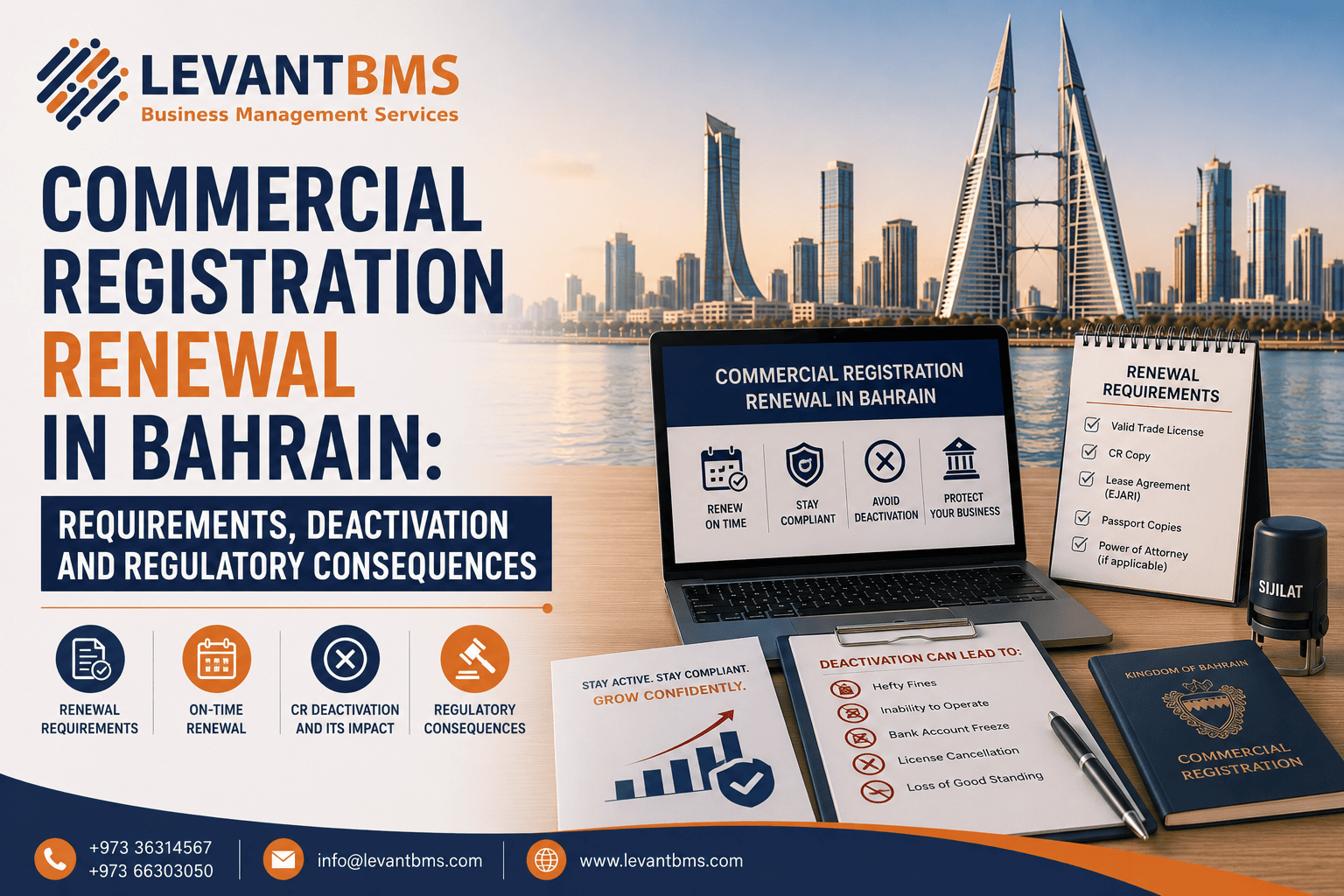
Renew your Commercial Registration (CR) annually → required by MOIC and linked to your Chamber of Commerce membership.
-
Track LMRA visas and Bahrainization quotas → make sure your workforce planning complies with labor laws.
-
Run compliant payroll and HR → follow Bahraini labor regulations for contracts, leave, and end-of-service benefits.
-
Stay updated on global reforms → especially OECD’s Pillar Two rules for multinationals and sector-specific regulations.
LevantBMS helps clients build a compliance calendar to ensure none of these critical tasks are missed.

Banking in Bahrain: What Entrepreneurs Should Know
Requirements: CR, MOA, lease contract, shareholder passports, UBO chart.
Timeline: Account opening can be done in one day, however, some banks may require more time depending on the applicant means and nationality
Tip: Choose banks already familiar with your sector (e.g., FinTech, consultancy, trading) to speed up approvals.
Taxes and VAT Snapshot (2025)
- Standard VAT: 10% on some most goods and services.
- Threshold: Registration for VAT is only mandatory when the business annual turnover exceeds BD 37,500 mandatory ( $100,000).
- Corporate Tax: There is none, except oil and gas.
Key Sectors Powering Bahrain’s Economy
- FinTech and Digital Finance: CBB’s Sandbox enables real-world testing under supervision, attracting payments, open banking, and blockchain players.
- ICT and Cloud: Liberalized telecoms and strategic data-center growth support SaaS and AI vendors.
- Logistics & Manufacturing: Competitive operating costs and specialized zones (e.g., Bahrain Logistics Zone, BIIP) support regional distribution and value-added production.
- Tourism & Retail: Ongoing hospitality and luxury retail expansion broadens consumer demand and FDI.
Setting Up a Business in Bahrain: The Clear Path
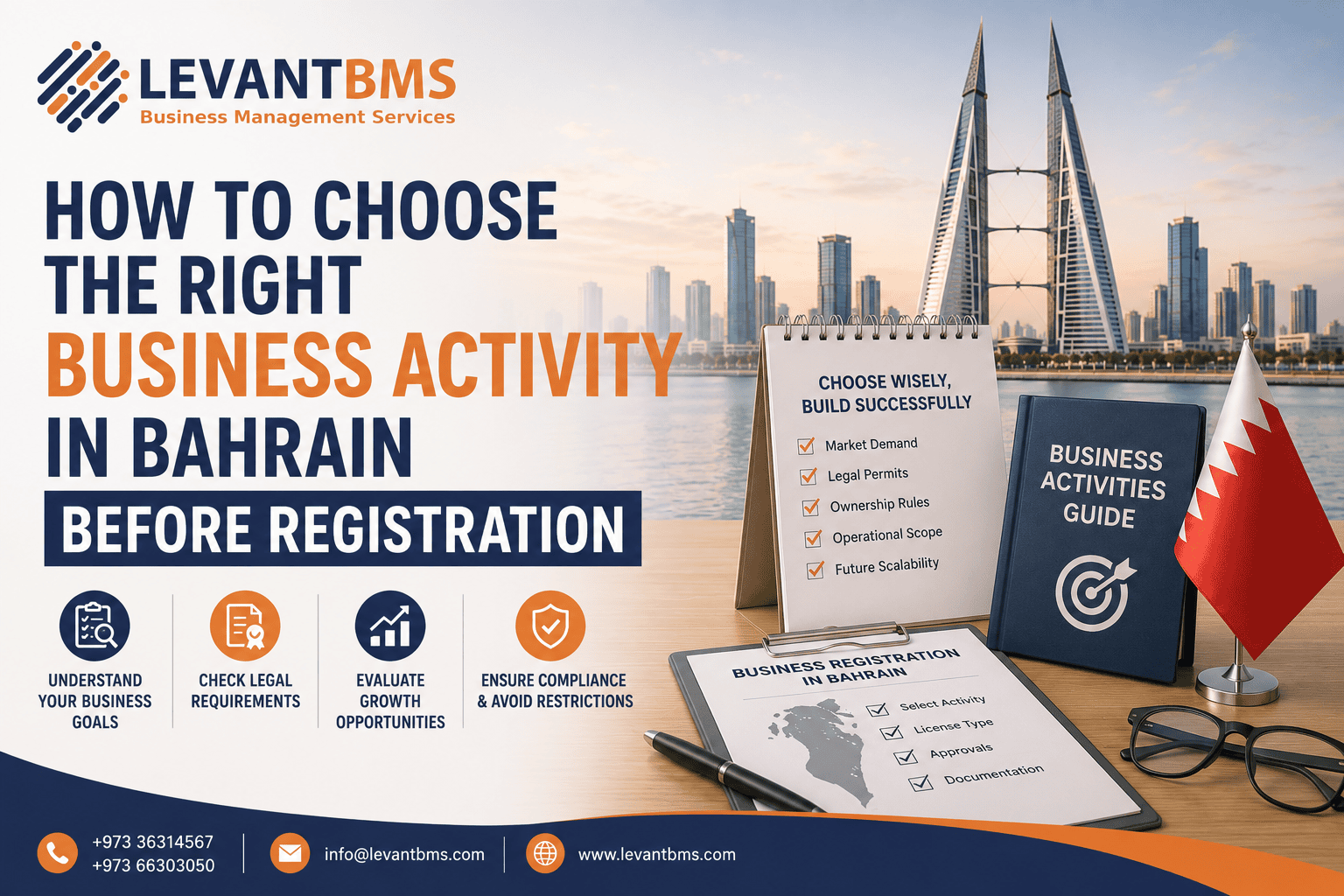
- Choose your company structure and activity.
- Apply for a Commercial Registration (CR) via the Sijilat portal (initial approval + trade name).
- Secure a physical office lease (mandatory for CRs).
- Set up your banking and compliance basics (corporate bank account, VAT registration if required).
Costs and Competitiveness: How Bahrain Compares
- Up to 48% total cost advantage vs. regional peers for operating a financial services firm with a tech hub (EY 2025).
- Lower labour, business licensing, and office costs relative to other GCC hubs.
Challenges to Plan For (and How We Help)
- Regulatory mapping: Some activities (finance, healthcare, education, etc.) require extra approvals. LevantBMS builds the license roadmap and handles submissions.
- Visa/workforce planning: LMRA quotas, Bahrainization where applicable, and medicals can impact timelines as we plan headcount and sequence applications.
- VAT readiness: Pricing, contracts, ERP setups, and invoice formats must meet NBR rules. We implement a VAT-compliant process from day one.
How LevantBMS Grows Bahrain Businesses (End-to-End)
- Market entry and feasibility: TAM/SAM sizing, competitor scans, and JV/partner options aligned with Vision 2030 sectors.
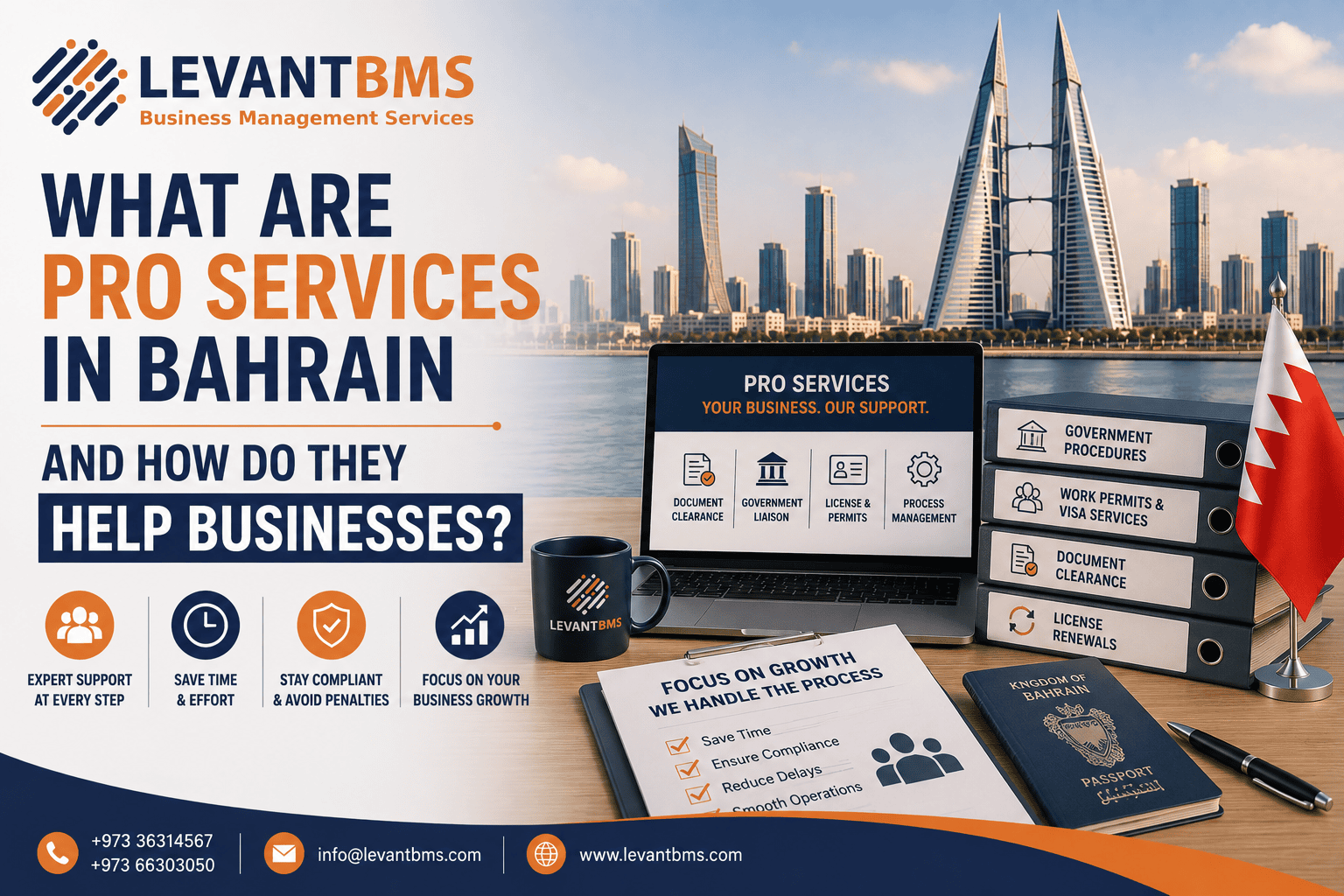
- Entity setup and licensing: CR, activity mapping, regulator approvals, and corporate banking.
- Talent and mobility: LMRA work permits, onboarding, HR policies.
- Scale services: Government incentives, export pathways, and cross-GCC expansion playbooks.
Vision 2030 and The Future of Bahrain Business
Bahrain vs. Other Gulf Hubs: The Short Take
- Versus UAE: Dubai is larger and denser with opportunities, but Bahrain’s cost base is materially lower, especially for financial-tech hubs, while keeping regional access and English-speaking talent.
- Versus Saudi Arabia: KSA offers sheer market scale; Bahrain offers speed-to-license and ownership flexibility that’s attractive for HQs, R and D, and regulated pilots (e.g., FinTech) serving the region.
Practical Checklist (What We Execute For You)
- Activity and structure selection → confirm ownership rules and regulators.
- Name reservation and initial approvals → obtain CR.
- Office lease and bank account → choose compliant premises, open account(s).
- Final licenses → municipal + sector approvals in one timeline.
- VAT registration and systems → map threshold, implement invoicing & returns.
- LMRA visas and onboarding → sponsorship, medicals, residence permits.
Conclusion: Start Your Bahrain Business with LevantBMS
FAQs on Starting a Business in Bahrain
1. How long does it take to start a business?
2–4 weeks for a WLL, longer for regulated sectors.
2. What are the typical setup costs?
Commercial Registration (CR) fees (BD 196), notarization, plus office lease.
3. Can I run my company remotely with a Bahrain CR?
Yes, but a local address (physical) is required.
4. How does LMRA affect foreign hiring?
LMRA sets visa quotas, requires Bahrainization compliance, and medical clearance for expats.