If you plan to grow your business in Bahrain, company registration in Bahrain should be your top priority. “A Commercial Registration (CR) in Bahrain is the official license issued by the Ministry of Industry and Commerce (MOIC) that gives your company the legal right to operate”. Bahrain provides a strong and stable business environment for those who want to take advantage of opportunities in the Gulf region. Its government supports businesses, its location is strategic, and it has solid infrastructure, making it a top destination for international investors and local entrepreneurs.
Starting a company in Bahrain is a simple process, but understanding the local rules and regulations for business is crucial. This guide will help you understand why registering in Bahrain benefits your business, what types of companies you can set up, the steps to follow, and how Levant Business Management Services can make the process easier for you to register and set up your company in Bahrain.
Quick Answers: Company Registration in Bahrain at a Glance
What is company registration in Bahrain?
Company registration in Bahrain is the legal process of incorporating a business entity with the Ministry of Industry and Commerce (MOIC) through the SIJILAT Portal, resulting in a Commercial Registration (CR) that authorizes the company to operate.
How long does it take?
Most standard company setups are completed within 2 to 3 weeks. Regulated companies that need Central Bank of Bahrain (CBB) approval take longer, because the CBB needs a minimum of two months to respond, so the realistic timeline for them is a minimum of three months.
Can foreigners own 100% of a company?
Yes. Bahrain permits Foreign Ownership in Bahrain across the majority of commercial activities, with no requirement for a local Bahraini sponsor in most sectors.
How much does it cost?
It depends on the business activity and its licensing requirements. The government fees are fixed: the Commercial Registration fee is BD 196 for up to three activities, plus BD 100 for each additional activity, notarisation is BD 100, and annual CR renewal starts from BD 166 depending on the share capital. Professional fees vary by scope, so a detailed quotation is prepared for each case.
What documents are required?
Core requirements include passport copies, proof of address, the Memorandum and Articles of Association, a lease agreement, and, for corporate shareholders, a board resolution and power of attorney.
Can I get an investor visa?
Yes. Once the Commercial Registration is issued, eligible shareholders can apply for an Investor Visa Bahrain through the Labour Market Regulatory Authority (LMRA).
Why Register a Company in Bahrain?
1. Business-Friendly Policies
Bahrain has built a strong reputation as one of the most welcoming places to start or run a business in the Gulf. Whether starting a small company or a global corporation, Bahrain’s business-friendly rules make the process smooth, with lower costs, tax breaks, and easy steps. The government continuously focuses on maintaining good conditions to help companies succeed.
2. Tax Advantages
Bahrain has no personal income tax at all, so residents keep their full salary with no brackets or filing obligations. Corporate income tax is generally 0% for most businesses, apart from oil and gas companies, which pay 46% on net profits. Since January 2025, a 15% Domestic Minimum Top-up Tax applies to large multinational groups with global revenue of €750 million or more, effective for fiscal years starting on or after 1 January 2025. VAT is charged at a standard rate of 10%. Overall, Bahrain remains one of the most tax friendly jurisdictions in the Gulf, relying mainly on VAT, social contributions, and targeted levies rather than broad income or corporate taxes. There are also no restrictions on money transfer.
3. Access to Regional and Global Markets
Bahrain’s location brings it close to big markets like Saudi Arabia, the UAE, and the larger MENA area. Businesses here can connect to the rising need for goods and services across the Middle East and North Africa. Also, Bahrain benefits from several free trade agreements, including the Bahrain-U.S. Free Trade Agreement.
4. Stable Political and Economic Environment
Bahrain has a long record of political stability, and its leaders focus on political stability for economic diversification. Compared to some nearby nations, Bahrain has developed a strong economy that does not rely on oil, making it a safer option for businesses looking to invest.
5. Strategic Gulf Location and GCC Market Access
Bahrain sits at the heart of the Gulf Cooperation Council (GCC), connected to Saudi Arabia by the King Fahd Causeway and within easy reach of Qatar, Kuwait, Oman, and the UAE. A single Bahrain Company Incorporation therefore gives investors a credible regional base from which to serve a combined GCC market of more than 55 million consumers, without the higher setup and operating costs associated with some neighbouring jurisdictions.
6. 100% Foreign Ownership Across Most Activities
Bahrain permits Foreign Ownership in Bahrain of up to 100% across several hundred approved commercial activities, overseen by the Ministry of Industry and Commerce (MOIC) and promoted internationally by the Bahrain Economic Development Board (EDB). This removes the need for a local Bahraini partner in the large majority of sectors, giving foreign investors full control over management, profits, and strategic decisions.
7. Low Operating Costs
Office rents, licensing fees, and staffing costs in Bahrain are generally lower than in comparable Gulf hubs, which makes Business Setup in Bahrain particularly attractive for startups, SMEs, and professional service firms that are cost-conscious in their early years of operation.
8. Strong Banking Sector and Skilled Workforce
Bahrain is home to one of the oldest and most diversified financial centres in the Gulf, with local and international banks such as Ahli United Bank, Bank ABC, and Kuwait Finance House offering corporate banking services. Alongside this mature banking sector, Bahrain offers a bilingual, well-educated workforce and a national workforce-support scheme, Tamkeen, that helps employers offset the cost of hiring and training Bahraini staff.
Main Company Structures in Bahrain
| Entity Type | Ownership | Capital | Best for |
| WLL (LLC) | One or more partners (up to 50), 100% foreign allowed | Flexible | SMEs, trading, consultancy |
| BSC (Public/Closed) | Public or private shareholders | Higher capital | Large firms, IPOs |
| Branch | 100% foreign-owned | No capital | Multinational expansions |
Understanding Every Business Structure in Bahrain
Choosing the right legal structure is one of the most consequential decisions in any Company Formation in Bahrain project. The breakdown below expands on each structure available through SIJILAT, including who it suits, minimum shareholder requirements, permitted foreign ownership, key advantages, and practical limitations.
With Limited Liability (WLL)
A With Limited Liability (WLL) company is Bahrain’s equivalent of a limited liability company (LLC) and remains the most widely used structure for small and mid-sized businesses.
- Who it suits: SMEs, trading firms, and consultancy businesses with two or more partners.
- Minimum shareholders: One or more, up to a maximum of fifty. A WLL can now be owned by a single partner or by several partners.
- Foreign ownership: Up to 100% in most non-restricted activities.
- Advantages: Flexible capital requirements, limited liability, and broad activity eligibility.
- Limitations: Certain regulated or strategic activities may require additional approvals or a minimum paid-up capital.
Partnership Company
A partnership company suits professional practices, such as law or accounting firms, where two or more partners share management and liability under a joint name.
- Who it suits: Professional partners who want to trade under a shared name and share responsibility directly.
- Minimum shareholders: Two.
- Foreign ownership: Permitted, though some professional activities require a locally licensed partner.
- Advantages: Straightforward formation and flexible shared management.
- Limitations: General partners typically carry unlimited personal liability for the partnership’s obligations.
Branch Office
A Branch Office allows an existing local or regional company to operate in Bahrain under its parent company’s name and licence, without forming a separate legal entity.
- Who it suits: Established companies expanding an existing brand into Bahrain.
- Minimum shareholders: Not applicable; the branch is an extension of the parent company.
- Foreign ownership: 100%, since the branch has no independent shareholding.
- Advantages: Faster market entry and direct use of the parent company’s track record and contracts.
- Limitations: The parent company remains fully liable for the branch’s activities and obligations in Bahrain.
Foreign Company Branch
A Foreign Company Registration in Bahrain in the form of a foreign company branch follows a similar principle to a domestic branch, but applies specifically to companies incorporated outside Bahrain.
- Who it suits: Multinational corporations delivering contracts, projects, or regional services from a Bahrain base.
- Minimum shareholders: Not applicable.
- Foreign ownership: Generally permitted, subject to MOIC approval and any activity-specific regulatory requirements.
- Advantages: Enables multinational groups to bid for regional contracts without incorporating a new subsidiary.
- Limitations: Scope of activity is usually limited to what is stated in the parent company’s licence, and renewal is tied to the parent entity’s continued good standing.
Bahrain Shareholding Company (BSC)
A Bahrain Shareholding Company (BSC) is the structure used for larger enterprises and can be established as either BSC (Closed) or BSC (Public), the latter being suitable for companies planning an eventual listing or public share offering.
- Who it suits: Large enterprises, group holding structures, and companies planning an IPO.
- Minimum shareholders: Typically two for a BSC (Closed), and a higher number, with wider public participation, for a BSC (Public).
- Foreign ownership: Permitted, subject to activity-specific rules and Central Bank of Bahrain approval for regulated financial activities.
- Advantages: Access to larger capital pools, credibility for large-scale operations, and a route to public listing.
- Limitations: Higher minimum capital requirements, more complex governance, and closer regulatory scrutiny.
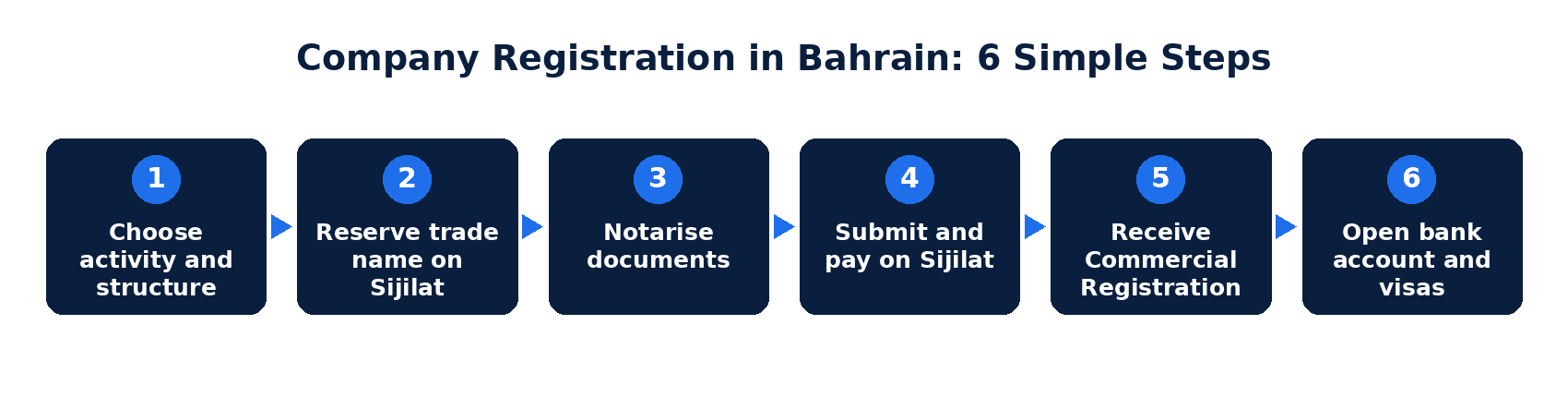
Company Registration in Bahrain Requirements and Steps
Once you’ve decided on the type of company you want to register, Levant Business Management Services will help you go through all the steps necessary to establish your business and investment in Bahrain.
- Choose your business activity and confirm it against the MOIC-approved activity classification list.
- Reserve your trade name through the SIJILAT Portal, valid for 60 days from approval.
- Prepare documents (IDs, trade name, capital, Power of Attorney).
- Apply for initial CR (includes security clearance and draft CR).
- Secure office lease and obtain municipal approval.
- Draft & notarize MOA (Memorandum of Association).
- Deposit capital in bank and obtain a certificate.
- Receive ACTIVE CR from the Ministry of Industry and Commerce.
- Register with Bahrain Chamber of Commerce and Industry (mandatory by law).
- Apply for visas for investors or employees (via LMRA).
Documents Required for Company Registration in Bahrain
Exact requirements vary by structure and nationality, but the table below summarises what most applicants need to prepare before submitting a SIJILAT application.
The core documents needed to register a company in Bahrain are:
- Power of Attorney or Apostilled Authorisation signed by all partners, authorising your service provider to represent them before the Ministry of Industry and Commerce and other government authorities in Bahrain.
- Copies of the passport and identification documents of all proposed shareholders.
- Share capital amount in BD (required later).
- Proposed shareholding structure where there is more than one shareholder (percentage of each partner).
- Three proposed company names in order of preference.
- Details of the proposed business activities of the company.
- An email account.
- A telephone number.
Please note: a residential address is not required for company registration.
Company Registration Cost Breakdown
The government fees below are official and fixed. Professional fees depend on the scope of work and are quoted per case.
The overall cost of establishing a company in Bahrain depends on the nature of the proposed business activity and its licensing requirements. Activities that require additional approvals, regulatory clearances, or multiple licences will generally involve higher establishment costs. A detailed quotation should therefore include all government fees, licensing and regulatory charges, third party expenses, and the professional fees payable to the service provider.
Government fees at a glance:
| Item | Amount |
| Commercial Registration (CR) government fee | BD 196 for up to 3 activities, plus BD 100 for each additional activity |
| Notarisation | BD 100 |
| Annual CR renewal | From BD 166, depending on the share capital (which also affects the Chamber of Commerce fee) |
| LMRA work permit | BD 205 per person per year, renewable for one or two years |
Registration Timeline
A realistic Company Registration in Bahrain timeline typically runs as follows:
Business Name Reservation → Initial Approval → Commercial Registration (CR) → Investor Visa → Corporate Bank Account → Business Launch
- Business name reservation: 1 to 2 business days.
- Initial approval and security clearance: 3 to 7 business days.
- Commercial Registration (CR) issuance: 5 to 10 business days once documents and capital are in order.
- Investor and employee visas: 1 to 3 weeks, often processed in parallel with the final CR steps.
- Corporate bank account opening: 1 to 3 weeks, depending on the bank’s KYC process.
- Typical total, from start to operational launch: approximately 2 to 3 weeks for a standard WLL. Regulated companies that need Central Bank of Bahrain approval take a minimum of three months.
What Is a Commercial Registration (CR)?
A Commercial Registration (CR) is the official licence issued by the Ministry of Industry and Commerce (MOIC) that legally authorises a company to trade in Bahrain. Every company, regardless of structure, must hold an active CR before it can operate, open a corporate bank account, or sponsor employee visas.
- Who issues it: The Ministry of Industry and Commerce (MOIC), through the SIJILAT Portal.
- Why it is needed: It confirms the company’s legal name, activities, shareholders, and registered address to third parties, banks, and government bodies.
- Renewal frequency: The CR must be renewed annually; failure to renew can result in fines or suspension of the licence.
- Amendment process: Changes to shareholders, activities, capital, or address are filed as CR amendments through SIJILAT and typically require supporting board resolutions or notarised documents.
Foreign Ownership in Bahrain
Foreign Ownership in Bahrain is permitted at up to 100% across the large majority of commercial activities approved by the Ministry of Industry and Commerce (MOIC), making Bahrain one of the more liberal jurisdictions in the Gulf for international investors.
- GCC investors: Citizens of Saudi Arabia, Kuwait, Oman, Qatar, and the UAE generally receive the widest access to commercial activities under GCC economic agreements.
- Non-GCC investors: Most non-GCC nationals can also access full ownership across several hundred approved activities, though some categories require additional approval.
- American investors: Under the Bahrain-U.S. Free Trade Agreement, U.S. nationals benefit from an even broader list of activities eligible for full foreign ownership.
- Restricted sectors: Banking, insurance, certain media, upstream oil and gas activities, and a small number of trading or agency activities may require special licensing, a local partner, or Central Bank of Bahrain approval.
Investor Visa Bahrain: Eligibility and Process
Once a company holds an active Commercial Registration (CR), its shareholders and senior staff can apply for an Investor Visa Bahrain through the Labour Market Regulatory Authority (LMRA) and the General Directorate of Nationality, Passports and Residence.
- Eligibility: Shareholders, partners, and appointed managers of a registered company with an active CR.
- Process: The application is submitted with the CR, passport copies, and supporting company documents, followed by medical and security clearance.
- Validity: Investor visas are typically issued for one to two years and are renewable alongside the CR.
- Family visa: Visa holders can generally sponsor a spouse and children as dependants once income and accommodation conditions are met.
- Employee visas: Additional staff visas are processed through LMRA once the company has an active CR and, where relevant, a registered office.
- Renewal: Visas must be renewed before expiry, in line with CR renewal and LMRA fee payments.
Work permit process and fees:
To obtain a work permit, the company must first be registered with the Labour Market Regulatory Authority (LMRA). The client then applies for the work permit, completes a medical check up on the designated form issued by the LMRA, pays the fees of BD 205 per person per year, and obtains the ID card.
Opening a Corporate Bank Account in Bahrain
Opening a corporate bank account is one of the final steps in most Company Registration in Bahrain projects, and banks apply thorough know-your-customer (KYC) checks before releasing funds against the CR.
- Required documents: Active CR, Memorandum and Articles of Association, shareholder passports, proof of address, and a board resolution naming authorised signatories.
- Minimum capital: Some business activities or banks may require evidence of paid-up capital or an initial deposit before completing the company registration or opening a corporate bank account.
- Compliance requirements: Banks conduct anti-money-laundering (AML) checks and may request a business plan or source-of-funds evidence for foreign shareholders.
- Typical banks: Ahli United Bank, Bank ABC, Bahrain Islamic Bank (BisB), Kuwait Finance House (KFH), and Al Salam Bank are commonly used for corporate accounts.
Annual Compliance Requirements
Registering the company is only the first step. Ongoing Business License Bahrain compliance keeps the company in good standing with MOIC and other regulators.
- CR renewal: Filed annually with MOIC through SIJILAT, with fees due before the expiry date.
- Accounting and bookkeeping: Companies must maintain proper accounting records in line with Bahraini commercial law.
- Financial statements: Larger companies and BSCs are generally required to prepare audited financial statements each year.
- VAT: Registration with the National Bureau for Revenue (NBR) is mandatory once annual taxable turnover exceeds BD 37,500, at the standard 10% rate.
- Labour Market Regulatory Authority (LMRA): Employers must keep work permits and visas current and report changes in staffing.
- Municipality requirements: The municipal licence tied to the registered office must be renewed alongside the CR.
Common Mistakes to Avoid When Registering a Company in Bahrain
- Choosing the wrong business activity, which can delay approvals or require a costly amendment later.
- Selecting an unsuitable legal structure for the intended shareholding or growth plans.
- Submitting incomplete or unnotarised incorporation documents.
- Signing an office lease that does not meet municipal or MOIC address requirements.
- Missing annual CR, visa, or municipality renewal deadlines.
- Overlooking sector-specific approvals, such as those required from the Central Bank of Bahrain for regulated financial activities.
How Levant Business Management Services Can Help
Setting up a company in Bahrain often feels complex if you are a first-time entrepreneur or someone investing from another country. Levant Business Management Services provides professional consultancy and complete assistance to help businesses establish their presence in Bahrain.
- Expert Guidance: We walk you through each part of the journey and make sure your business aligns with Bahraini laws.
- Easy Processing: You won’t need to deal with forms or documentation because we take care of everything to avoid mistakes or delays.
- Personalized Support: Our team creates plans that match your specific goals and needs, helping your company setup and run smoothly.
- Regulatory Adherence: We help keep your business within local laws to prevent future legal problems.
- Faster Approvals: Our experience with Bahrain’s regulatory procedures helps minimise documentation errors and unnecessary delays throughout the registration process.
- Direct Government Liaison: We assist with coordinating submissions and communication with the relevant government authorities throughout the registration process.
- Licensing Support: We help secure sector-specific approvals, including those required for regulated activities.
- Visa Processing Assistance: We coordinate investor, employee, and dependant visa applications through LMRA.
- Ongoing Compliance Management: We track CR renewals, financial statement deadlines, and VAT obligations so nothing is missed.
Bahrain vs UAE: Business Setup Comparison
Bahrain and the UAE are often compared by investors evaluating a Gulf base. The table below outlines the main differences relevant to Business Setup in Bahrain versus the UAE. Specific costs and timelines should always be confirmed for the exact activity and emirate or governorate involved.
| Factor | Bahrain | UAE |
| Typical setup cost | Approximately BHD 1,000 to 2,500 | Mainland setup often costs more; free zone packages can be similar or lower depending on the zone |
| Foreign ownership | Up to 100% in most activities; no local sponsor required for the large majority of sectors | 100% foreign ownership permitted in most mainland activities since the 2021 reforms, and in free zones |
| Corporate tax | 0% for most sectors (46% for oil and gas); a minimum tax may apply to certain large multinational groups | 9% standard corporate tax above the exempt threshold, with 0% in qualifying free zones |
| Office cost | Generally lower average commercial rents than Dubai or Abu Dhabi | Higher average commercial rents, particularly in prime Dubai and Abu Dhabi areas |
| Registration time | Approximately 2 to 3 weeks for a standard company, and a minimum of three months for regulated companies that need CBB approval. | Free zones can be faster (days to two weeks); mainland timelines are broadly similar |
Conclusion:
LevantBMS has more than 23 years of legal and corporate experience building businesses in Bahrain. The Managing Director has more than a combined 35 years of legal experience in Saudi Arabia, UK and Bahrain. He is a British citizen and graduate of three UK Universities with a master’s degree in UK legal practice. LevantBMS will assist and guide you in a professional manner to achieve your goals with a very competitive professional fee compared to its peers.
In conclusion, company registration in Bahrain brings plenty of benefits to businesses wanting to grow in the Middle East. Bahrain offers a competitive tax environment, a supportive business ecosystem, and convenient access to regional markets, making it an attractive destination for business expansion.
For tailored guidance on the right structure, licensing route, and timeline for your project, explore our Business Setup Services and Company Formation guides, or get in touch with our team directly.
FAQ’s:
1. What is company registration in Bahrain?
Company registration in Bahrain is the legal process of establishing a business entity through the Ministry of Industry and Commerce (MOIC), completed via the SIJILAT Portal and confirmed by the issuance of a Commercial Registration (CR).
2. Can a foreigner register a company in Bahrain?
Yes. Foreign nationals can complete Foreign Company Registration in Bahrain directly, without needing to be a Bahraini citizen or resident at the time of application, though some activities require a locally registered address and, in a small number of sectors, a local partner.
3. Can foreigners fully own a Bahraini company?
Yes. Bahrain allows 100% foreign ownership in most business sectors. Certain regulated activities (like banking, insurance, and some professional services) may require special approvals, but for the majority of activities, no local sponsor is needed.
4. How much time does CR approval take?
For a straightforward WLL (LLC), approval can take 2 to 4 weeks if all documents are in order. More complex entities like BSCs or regulated businesses (finance, healthcare) may take longer due to additional approvals.
5. What documents are required to register a company?
Typical requirements include passport copies, proof of address, the Memorandum and Articles of Association, a registered office lease, and, for corporate shareholders, a board resolution and power of attorney. The full list depends on the chosen legal structure.
6. What are the government fees for CR?
Government fees vary depending on the business activity, legal structure, licensing requirements, and any additional approvals required. Applicants should confirm the applicable fees with the Ministry of Industry and Commerce (MOIC) or their business setup consultant.
7. How much does it cost to register a company in Bahrain in total?
The overall cost of establishing a company in Bahrain depends on the nature of the proposed business activity and its licensing requirements. Activities that require additional approvals, regulatory clearances, or multiple licences will generally involve higher establishment costs. A detailed quotation should therefore include all government fees, licensing and regulatory charges, third party expenses, and the professional fees payable to the service provider.
8. What is a Commercial Registration (CR)?
A Commercial Registration (CR) is the official licence issued by the Ministry of Industry and Commerce (MOIC) that legally authorises a company to operate in Bahrain. It must be renewed annually.
9. Which business structure is best for foreign investors?
Most foreign investors choose a With Limited Liability (WLL) company for its flexibility, as a WLL can now be owned by one or more partners. Larger groups that plan to raise capital or list often choose a Bahrain Shareholding Company (BSC).
10. Do I need a local sponsor in Bahrain?
No. Unlike some GCC countries, Bahrain does not require a local sponsor for most sectors. You can fully own and manage your company.
11. Can I apply for an investor visa after company registration?
Yes. Once your Commercial Registration (CR) is active, you can apply for an Investor Visa Bahrain through LMRA, which also allows eligible investors to sponsor family members.
12. How do I renew my Commercial Registration?
CR renewal is filed annually through the SIJILAT Portal, along with payment of the applicable government fee. Renewing on time avoids late penalties or suspension of the licence.
13. Can I add new business activities after incorporation?
Yes. Additional activities can usually be added to an existing CR as an amendment through SIJILAT, though some new activities may require fresh approvals or a higher paid-up capital.
14. Is a physical office required to register a company?
A registered business address is required for every company. Depending on the licensed business activity and applicable regulations, businesses may qualify to use a serviced office, flexible workspace, or dedicated commercial premises.
15. Can I open a corporate bank account after registration?
Yes, and in practice it is one of the final steps. Banks will request the active CR, company documents, and shareholder identification before opening a corporate account.
16. Why should I use a professional business setup consultant in Bahrain?
A consultant such as Levant Business Management Services can help streamline the registration process and reduce avoidable delays, prepare documents correctly the first time, liaise directly with MOIC and other authorities, and manage ongoing compliance after registration.
17. What is the VAT threshold in Bahrain?
The standard VAT rate is 10%. Businesses with annual taxable turnover exceeding BD 37,500 are generally required to register for VAT with the National Bureau for Revenue (NBR).