


For an established overseas business, entering the Gulf is rarely about starting from scratch. It is about extending an existing brand, team and track record into a new market. Bahrain makes that step easier than most of its neighbours: foreign investors can own 100% of a company in most sectors, there is no corporate income tax for most businesses, and registration runs through a single online platform.
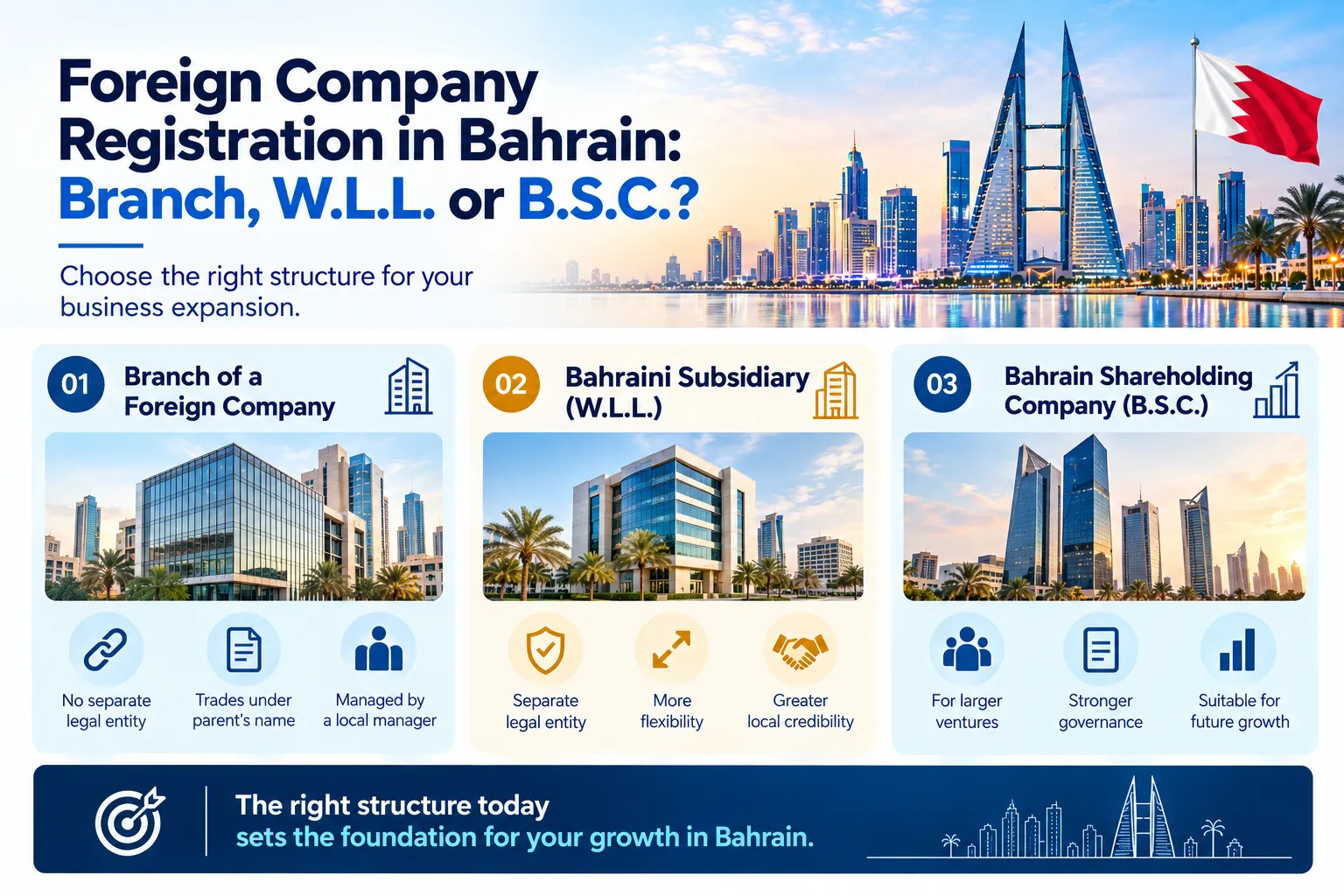
The first real decision, however, is structural. Should you open a branch of your existing company, incorporate a new Bahraini subsidiary, or set up a representative office first? Each option has different consequences for liability, control, banking and future growth. This guide compares the main routes for foreign company registration in Bahrain.
Option 1: Branch of a Foreign Company
A branch allows your overseas company to carry on licensed activities in Bahrain without creating a separate legal entity. Key features include:
- No separate legal personality. The parent company is fully liable for the branch’s obligations.
- Same name and activities. The branch normally trades under the parent’s name and within the scope of the parent’s existing activities.
- A local branch manager. A manager must be appointed to run the branch and deal with the authorities.
- Parent documentation. The application typically requires the parent’s constitutional documents, a board resolution and a parent guarantee, all properly legalised.
A branch suits companies that want direct operational control, plan to deliver services they already provide elsewhere, and are comfortable with the parent bearing the risk.
Option 2: A Bahraini Subsidiary (W.L.L.)
Most foreign investors choose to incorporate a new local company, usually a With Limited Liability Company (W.L.L.). A W.L.L. can be set up by two or more shareholders or by a single owner, so it suits both joint ventures and wholly owned subsidiaries. The subsidiary can be wholly owned by the foreign parent in most sectors.
The main advantages are:
- Limited liability. The subsidiary is a separate legal entity, which helps ring-fence risk from the parent.
- Flexibility. It can take on activities beyond those of the parent, admit local partners later and be sold or restructured more easily.
- Local credibility. Some clients, banks and government tenders prefer dealing with a Bahrain-incorporated entity.
For most commercial and service businesses, this is the most practical way to open a company in Bahrain. You can read more about the process on our company formation in Bahrain page.
Option 3: Bahrain Shareholding Company (B.S.C.)
A closed or public B.S.C. is generally used for larger ventures, regulated businesses, joint ventures with several institutional shareholders, or projects that may later seek investment or listing. It requires a board of directors and carries heavier governance and reporting obligations. If you are considering this route, our corporate governance services can help you build the right board structure from the start.
What About a Representative Office?
Some companies begin with a representative or regional office to test the market. Such offices are typically limited to marketing, liaison and promotional work and cannot generate revenue in Bahrain. They are useful for research, but most businesses convert to a branch or subsidiary once they are ready to trade.
Key Steps in Foreign Company Registration
Whichever structure you choose, the registration process with the Ministry of Industry and Commerce follows a similar sequence through the Sijilat portal:
- Confirm eligibility. Confirm that your intended activities are open to foreign ownership and identify any external licences.
- Choose the structure. Choose the legal structure and reserve the commercial name.
- Prepare documents. Prepare and legalise the parent company’s documents.
- Submit the application. Submit the application and obtain any sector approvals.
- Complete incorporation. Sign the Memorandum of Association (for a subsidiary), pay fees and receive the CR.
- Prepare for operations. Lease premises, open a bank account and apply for visas and work permits.
Our detailed guide to company registration in Bahrain explains each stage, and our blog on business activities with full foreign ownership lists which sectors are open to 100% ownership.
How to Choose the Right Structure
Ask yourself three questions. Do you want the parent to carry the liability? Will the Bahrain business do anything the parent does not already do? Do you expect to bring in local partners, investors or a buyer in the future? If the answers point to risk separation and flexibility, a subsidiary is usually the better fit. If you need a quick extension of existing operations, a branch may be enough.
How LevantBMS Supports Foreign Companies
LevantBMS has supported international businesses entering Bahrain for more than two decades. We assess the most suitable structure, review activity eligibility, coordinate document legalisation, manage the Sijilat application and handle post-registration steps such as banking introductions and visas. Learn more about our team or book a consultation to discuss your expansion plans.
Frequently Asked Questions
1. Can a foreign company register in Bahrain without a local partner?
Yes. In most commercial and service sectors, foreign companies can own 100% of a Bahraini entity or open a branch without a local partner. A limited number of activities remain restricted.
2. What is the difference between a branch and a subsidiary in Bahrain?
A branch is an extension of the foreign parent and has no separate legal personality, so the parent is liable for its obligations. A subsidiary, such as a W.L.L., is a separate legal entity with limited liability.
3. Which documents does a foreign parent company need?
Typically the certificate of incorporation, constitutional documents, a board resolution approving the Bahrain entity and identification of the authorised signatories, all properly legalised.
4. Can a representative office trade in Bahrain?
No. A representative office is generally limited to marketing, liaison and promotional activities and cannot generate revenue in Bahrain.
5. Can a branch be converted into a subsidiary later?
A business can restructure as it grows, for example by setting up a subsidiary and transferring operations. The right approach depends on contracts, licences and staff, so professional advice is recommended.