


Company incorporation in Bahrain produces two things. The first is the Commercial Registration (CR), which everyone focuses on. The second is the company’s constitution, which receives far less attention but governs how the business is owned, managed and controlled for years to come.
For most companies, that constitution is the Memorandum of Association (MoA). Many founders sign a standard template at registration and never read it again, until a shareholder wants to exit, a bank asks who can sign, or partners disagree. This guide explains what the MoA does, which clauses matter most and how to get it right when you incorporate a company in Bahrain.
What Is the Memorandum of Association?
The MoA is the constitutional document filed with the Ministry of Industry and Commerce (MOIC) when the company is incorporated. For a With Limited Liability Company (W.L.L.), the MoA sets out the company’s basic terms. A Bahrain Shareholding Company (B.S.C.) has both a Memorandum and Articles of Association. Where a W.L.L. has a single owner, the constitutional document may take the form of a declaration of incorporation, but it covers the same essential matters.
Because it is registered with the Ministry, the MoA is the document that banks, authorities and counterparties rely on when they need to know who owns and controls the company.
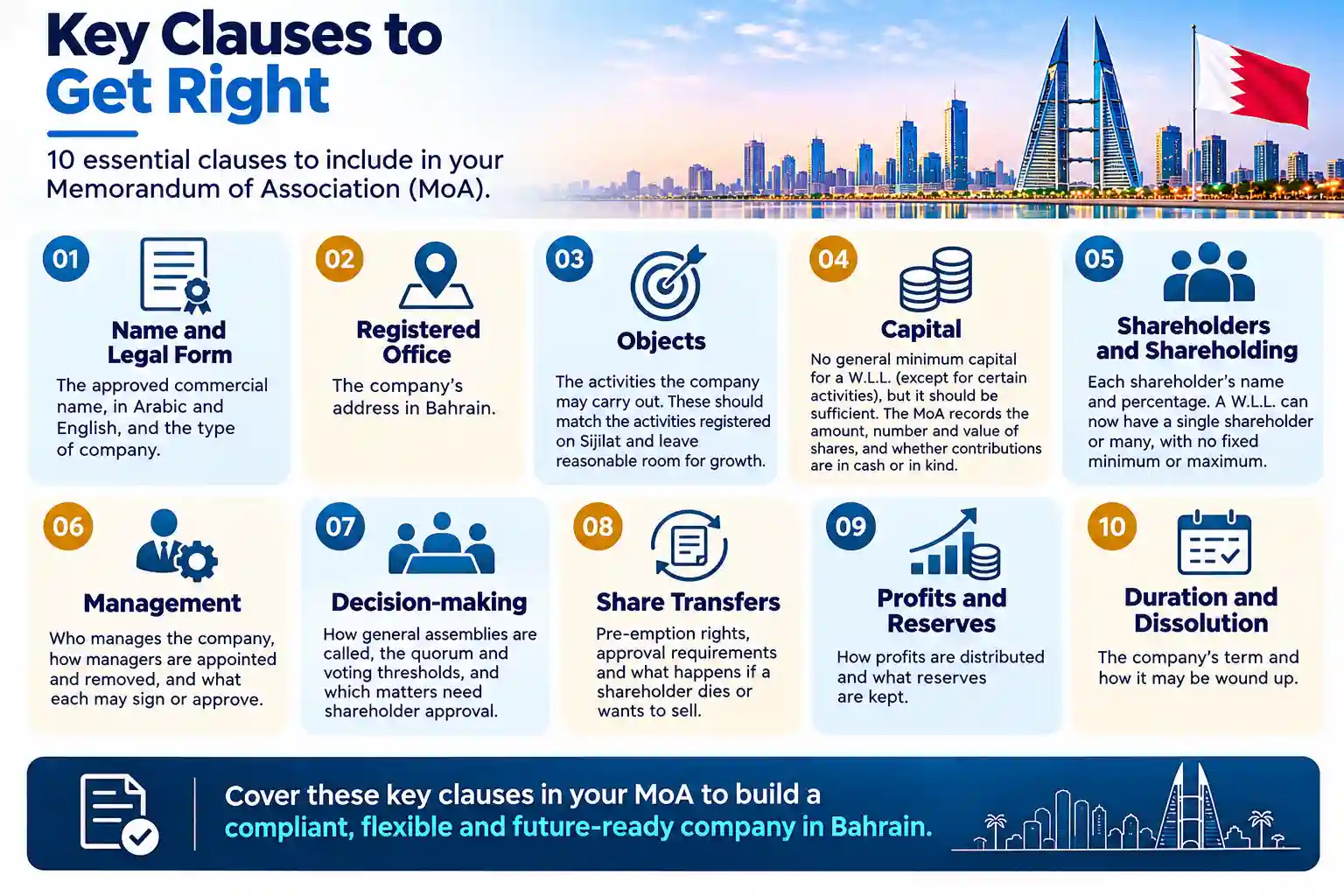
Key Clauses to Get Right
- Name and legal form. The approved commercial name, in Arabic and English, and the type of company.
- Registered office. The company’s address in Bahrain.
- Objects. The activities the company may carry out. These should match the activities registered on Sijilat and leave reasonable room for growth.
- Capital. Bahrain no longer imposes a general minimum capital for a W.L.L., except for certain activities, but the capital should be sufficient for the company to achieve its objectives. The MoA records the amount, the number and value of shares, and whether contributions are in cash or in kind.
- Shareholders and shareholding. Each shareholder’s name and percentage. A W.L.L. can now have a single shareholder or many, with no fixed minimum or maximum.
- Management. Who manages the company, how managers are appointed and removed, and what each may sign or approve.
- Decision-making. How general assemblies are called, the quorum and voting thresholds, and which matters need shareholder approval.
- Share transfers. Pre-emption rights, approval requirements and what happens if a shareholder dies or wants to sell.
- Profits and reserves. How profits are distributed and what reserves are kept.
- Duration and dissolution. The company’s term and how it may be wound up.
Common Drafting Mistakes
- Using a generic template that ignores the shareholders’ real arrangements.
- Objects drafted so narrowly that every new service needs an amendment.
- Managers given unlimited powers with no internal approval limits.
- No clear exit route or valuation mechanism for departing shareholders.
- An MoA that conflicts with a separate shareholders’ agreement.
MoA or Shareholders’ Agreement?
The MoA is a registered document, so it usually covers the core legal terms. Many investors also sign a private shareholders’ agreement dealing with funding obligations, deadlock, non-compete terms and detailed exit rights. The two documents must be consistent, otherwise the registered MoA may prevail in practice. Good corporate governance starts with aligning them at incorporation.
Amending the MoA After Incorporation
Companies evolve, and the MoA can be amended through the appropriate shareholder resolutions and an update filed through Sijilat. Typical amendments include new shareholders, capital changes, new activities and changes in management. Larger changes, such as bringing in an investor or selling the business, are often handled alongside mergers and acquisitions advice.
How LevantBMS Helps
LevantBMS drafts and reviews constitutional documents as part of every company formation in Bahrain. We tailor the MoA to your ownership structure, align it with any shareholders’ agreement and make sure it reflects your registered activities. For a step-by-step overview of the full process, see our guide on how to incorporate a company in Bahrain, or book a consultation.
Conclusion
The Memorandum of Association is far more than a registration formality. A well-drafted MoA protects shareholders, supports banking and compliance, and makes future growth easier. Taking time to get it right at incorporation is one of the best investments a new Bahrain company can make.
Frequently Asked Questions
1. Is a Memorandum of Association required to incorporate a company in Bahrain?
Yes. Companies incorporated with the Ministry of Industry and Commerce must file constitutional documents, usually a Memorandum of Association, which sets out the company’s name, objects, capital, shareholders and management.
2. Is there a minimum capital for a W.L.L. in Bahrain?
There is no general minimum capital for a W.L.L., except for certain activities. However, the company’s capital should be sufficient for it to achieve its objectives.
3. Can a W.L.L. in Bahrain have only one shareholder?
Yes. A W.L.L. can be owned by a single shareholder or by several, as there is no longer a fixed minimum or maximum number of shareholders.
4. Can the Memorandum of Association be changed after incorporation?
Yes. It can be amended through the required shareholder resolutions, with the changes updated through the Sijilat system.
5. What is the difference between an MoA and a shareholders’ agreement?
The MoA is the company’s registered constitutional document. A shareholders’ agreement is a private contract between shareholders that usually covers funding, deadlock and exit arrangements in more detail. The two should be consistent.