
One of the reasons investors choose Bahrain is its compact, accessible government. Decision-makers are reachable, procedures are largely digital and the main authorities work closely together. Yet for someone arriving from abroad, the number of acronyms can be confusing. EDB, CBB, MOIC, LMRA, NBR: who does what, and which of them will you actually deal with?
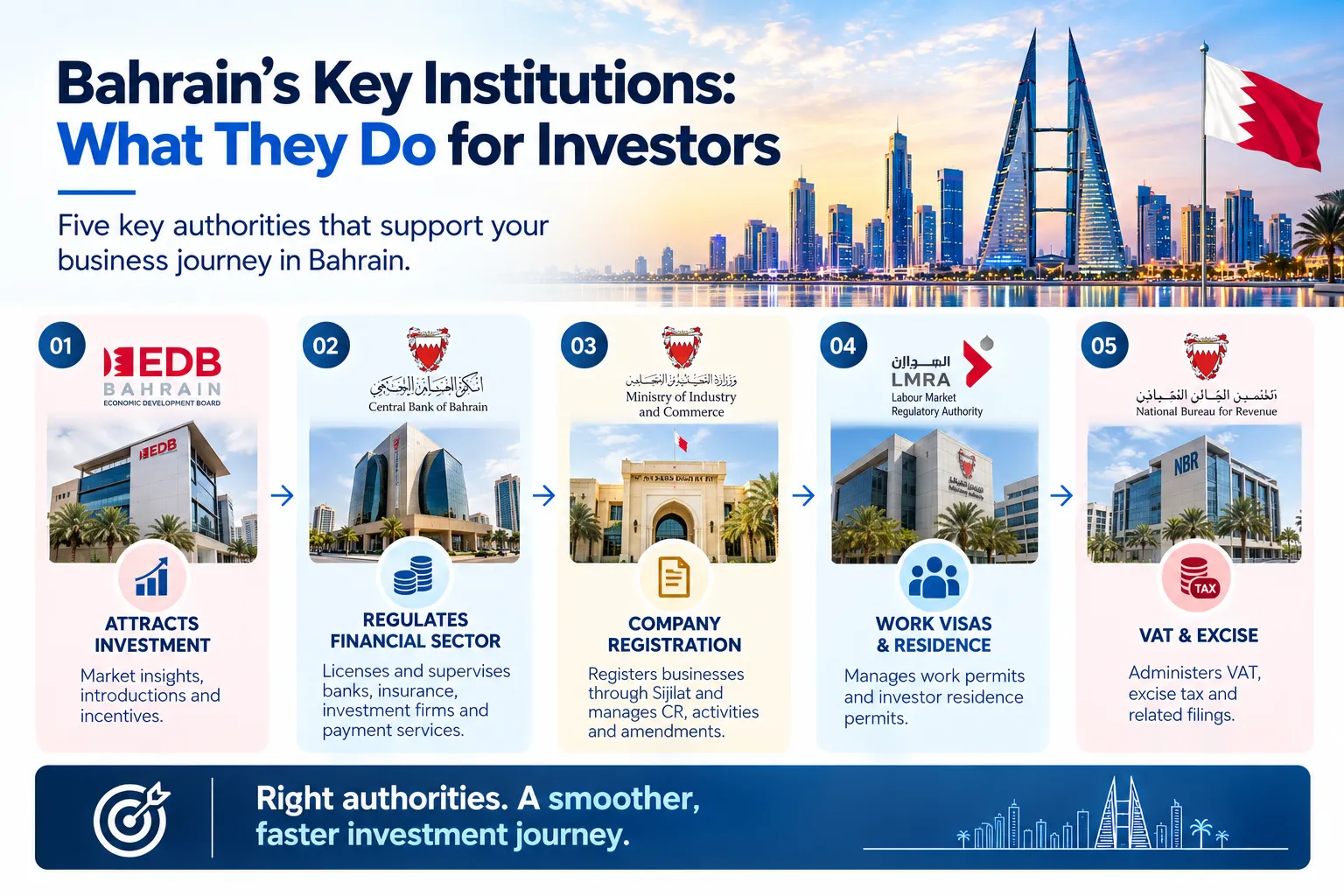
This guide explains the role of each key institution in the investment journey, so you can plan your Bahrain investment with a clear picture of who approves, licenses and supervises your business.
Bahrain Economic Development Board (EDB)
The Bahrain Economic Development Board is the Kingdom’s investment promotion agency. Its role is to attract and support investment in priority sectors such as financial services, technology, manufacturing, logistics, tourism and healthcare.
For investors, the EDB is usually the first point of contact for:
- market information and sector insights;
- introductions to government bodies, partners and service providers;
- guidance on incentives and programmes available in specific sectors; and
- facilitation support for larger or strategic projects.
The EDB does not issue your Commercial Registration, but it can help you understand the landscape before you commit capital.
Central Bank of Bahrain (CBB)
The Central Bank of Bahrain is the country’s monetary authority and the single regulator of its financial sector. It licenses and supervises banks, insurance firms, investment businesses, capital markets participants, payment service providers and crypto-asset service providers.
If your business involves managing money, offering financial products, providing payment services or handling digital assets, you will need CBB authorisation before you can operate. This means meeting requirements on capital, governance, fit-and-proper management, systems and controls and ongoing reporting. Our recent article on the AX Coins CBB licence shows how this framework applies to new areas such as stablecoins.
Ministry of Industry and Commerce (MOIC)
The Ministry of Industry and Commerce oversees commercial registration and the Commercial Companies Law. Through its Sijilat portal, it registers new companies, approves commercial names, records activities, shareholders and managers, and handles CR renewals and amendments. Almost every investor will deal with the MOIC, regardless of sector. See our company registration in Bahrain service for how this works in practice.
Labour Market Regulatory Authority (LMRA)
The LMRA manages work permits and residence-related permits for expatriate employees and investors. Once your company has its CR and premises, you can apply for work visas for staff and, where eligible, an investor residence permit for yourself. Our guide to the Bahrain investor visa and work permits explains the process.
National Bureau for Revenue (NBR)
The NBR administers VAT and excise tax. Bahrain has no general corporate income tax for most businesses, but companies whose turnover exceeds the VAT threshold must register for VAT and file regular returns. Large multinational groups should also review whether newer minimum tax rules apply to them.
Other Bodies Worth Knowing
- Tamkeen supports private-sector growth through funding and training programmes.
- Bahrain Bourse is the national stock exchange for listed securities.
- Sector regulators, such as health, education and municipal authorities, approve specific activities.
How These Institutions Fit Together
A typical investor journey might start with the EDB for market insight, move to the MOIC for company registration, involve the CBB if the activity is financial, continue with the LMRA for visas and finish with the NBR for tax registration. Getting the sequence right avoids delays, such as registering a company before confirming that its activity can be licensed.
How LevantBMS Supports Investors
Our investment advisory services in Bahrain help investors assess opportunities, choose the right structure and plan regulatory approvals from the outset. We coordinate with the relevant authorities, support company formation in Bahrain and advise on corporate governance for regulated businesses. For a broader introduction, read how to invest in Bahrain, or contact us to discuss your plans.
Frequently Asked Questions
1. What does the Bahrain Economic Development Board do?
The EDB is Bahrain’s investment promotion agency. It provides market information, introductions and facilitation support to investors considering priority sectors in the Kingdom.
2. When do I need a licence from the Central Bank of Bahrain?
You need CBB authorisation if your business carries out regulated financial activities, such as banking, insurance, investment business, payment services or crypto-asset services.
3. Does the EDB register companies in Bahrain?
No. Company registration is handled by the Ministry of Industry and Commerce through the Sijilat portal. The EDB supports investors with guidance and introductions.
4. Which authority issues investor and work visas in Bahrain?
Work permits and investor residence permits are managed by the Labour Market Regulatory Authority (LMRA) after the company has obtained its Commercial Registration.
5. Is there corporate tax in Bahrain?
Bahrain does not levy a general corporate income tax on most businesses. However, VAT applies to companies above the registration threshold, and specific rules may apply to oil and gas companies and large multinational groups.