Why Commercial Registration Renewal Matters
A Commercial Registration, commonly known as a CR, is fundamental to the legal operation of a business in the Kingdom of Bahrain.
Obtaining the CR is not, however, the end of the registration process. Businesses must maintain their registration and applicable licences and ensure that the information recorded with the Ministry of Industry and Commerce (MOIC) remains current.
Failure to renew a CR should therefore not be treated merely as an administrative delay. Once the CR is deactivated, the company’s ability to lawfully conduct its business is directly affected.
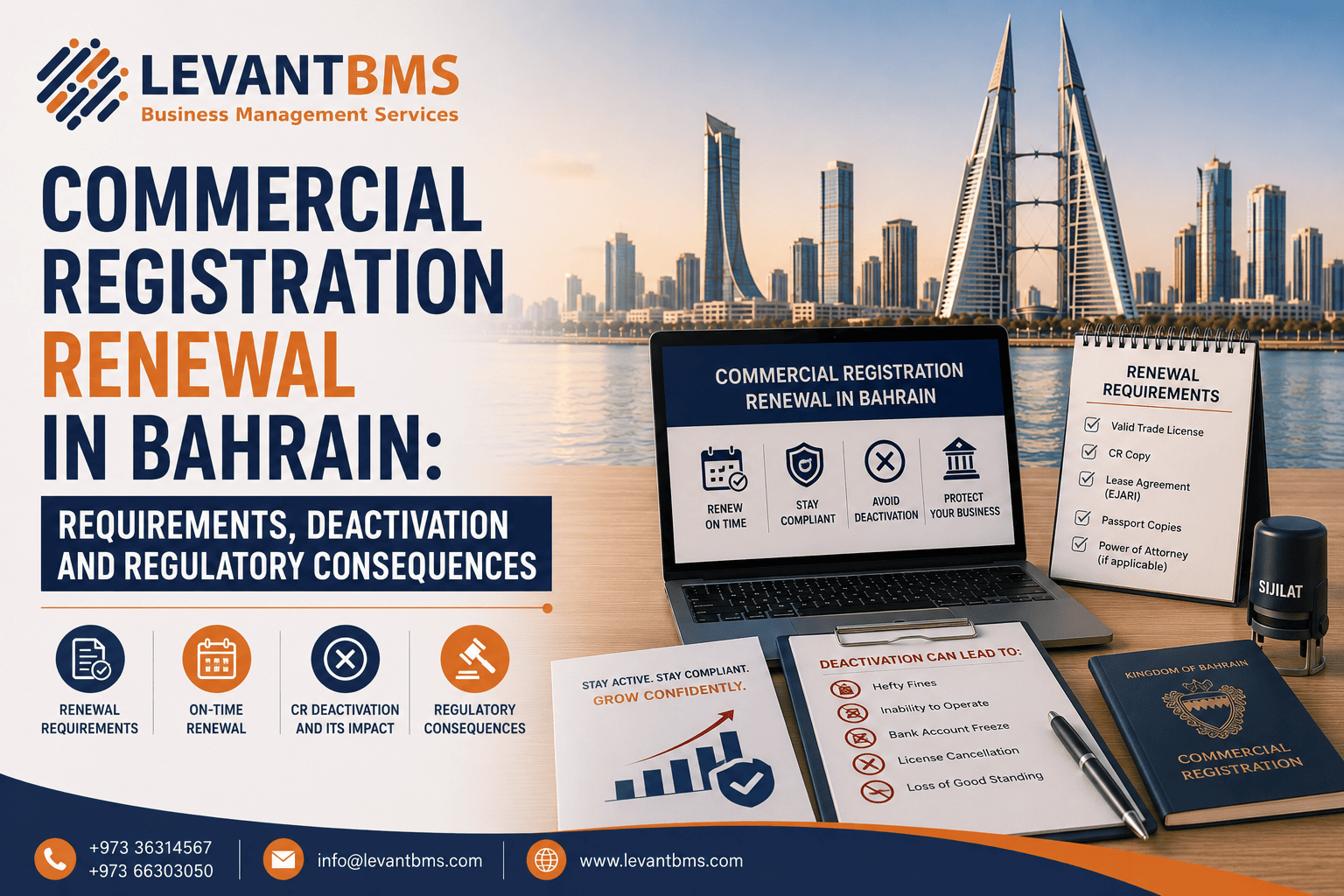
The MOIC expressly confirms that a business cannot practise its commercial activities while its CR status is “Deactivated for Not Renewing the CR”, because doing so is regarded as conducting business without a valid licence. (Ministry of Industry and Commerce)
What Should Be Reviewed Before Renewing a CR?
Before submitting a CR renewal application, a company should review its overall corporate and regulatory status rather than simply paying the renewal fee.
Depending upon the company and its activities, this may include confirming that:
- the CR information is current and accurate;
- the registered commercial address remains valid;
- the company’s licensed activities remain appropriate;
- any activity-specific licences or approvals remain valid;
- shareholder, director and authorised-signatory information is correctly recorded;
- Ultimate Beneficial Owner information has been properly maintained;
- required corporate filings have been made;
- audited financial statements have been filed where applicable;
- outstanding MOIC violations or regulatory observations have been addressed; and
- approvals required from other licensing authorities remain in force.
The exact requirements vary according to the company’s legal form and activities. MOIC directs businesses to Sijilat for the requirements applicable to individual commercial activities. (Ministry of Industry and Commerce)
For industrial businesses, for example, the Ministry states that the industrial licence is valid for one year and is automatically renewed together with the Commercial Registration renewal. (Ministry of Industry and Commerce)
What Happens if the CR Is Not Renewed?
Failure to renew can result in the CR being shown as deactivated for non-renewal.
The practical significance of this status is substantial: the business should not continue carrying on the licensed commercial activity as though its registration remained active.
The MOIC’s published guidance is clear that conducting commercial activities while the CR is deactivated for non-renewal is considered conducting business without a valid licence. (Ministry of Industry and Commerce)
Continued operation can therefore expose the company to regulatory action.
Where an entity conducts an unlicensed activity and fails to correct the position following warning, MOIC guidance also provides for administrative closure as an enforcement measure. (Ministry of Industry and Commerce)
Companies should consequently address an expired or deactivated CR immediately rather than allowing the position to continue.
Outstanding Violations Can Complicate Renewal
Renewal is also an appropriate time to identify whether the company has outstanding regulatory violations.
Depending upon the nature of the issue, simply submitting a renewal application may not resolve the underlying problem. The company may first need to rectify the violation or submit the appropriate violation-removal application through Sijilat.
MOIC provides specific procedures for violation removal through the Sijilat system. (Ministry of Industry and Commerce)
This is one reason companies should monitor their regulatory position throughout the year rather than discovering outstanding issues immediately before renewal.
Prolonged Inactivity Creates Additional Risk
Long-term failure to maintain the company can have consequences beyond temporary deactivation.
The Ministry states that companies which have not conducted their activities following completion of their establishment procedures, or which stop conducting business without acceptable justification for more than a calendar year, may be deleted from the Commercial Registration under the applicable provisions of the Commercial Companies Law and implementing decisions. (Ministry of Industry and Commerce)
There is therefore an important distinction between a temporary renewal problem and allowing a company’s legal and regulatory position to deteriorate over an extended period.
CBB-Regulated Companies: A More Serious Regulatory Dimension
The position requires particular attention where the company is a financial institution or other business licensed and regulated by the Central Bank of Bahrain (CBB).
A CBB-regulated business operates within two interconnected regulatory frameworks: its corporate and commercial registration position and its sector-specific CBB authorisation.
Maintaining the underlying corporate structure and required registrations is therefore an important part of the institution’s wider regulatory compliance framework.
A CBB licensee should not assume that a problem with its CR is simply an MOIC administrative issue.
The CBB conducts both onsite and offsite supervision of its licensees, including assessment of systems and controls, regulatory returns, audited financial statements, strategy and compliance. Where a licensee fails to satisfy applicable regulatory requirements, enforcement measures can include warnings, directions, information requirements, adverse fit-and-proper findings, financial penalties and investigations. The CBB states that extreme regulatory violations may result in cancellation of a licence, administration or criminal sanctions. (Central Bank of Bahrain)
Accordingly, while CR deactivation does not automatically mean that a CBB licence is immediately withdrawn, failure to maintain the corporate and licensing requirements applicable to a regulated institution can become a serious regulatory matter and should be addressed promptly.
This distinction is important: MOIC deactivation of the CR and CBB cancellation of a regulatory licence are separate regulatory actions, although a failure affecting the company’s legal ability to operate may have consequences for its continuing compliance with CBB requirements.
Regulatory Licences Must Be Managed Proactively
For regulated companies, renewal should form part of a broader compliance calendar covering all relevant corporate and regulatory obligations.
Management and the board should know well in advance when registrations, licences, approvals and filings become due.
Responsibility should be allocated internally, and any issue capable of preventing renewal should be identified sufficiently early to allow corrective action.
This is particularly important where an external authority’s approval is necessary or where a corporate change requires prior regulatory consent.
Corporate Changes Should Also Be Reflected in the CR
Renewal provides an opportunity to review whether the company’s registered information accurately reflects its current position.
During the year, a business may have changed directors, shareholders, authorised signatories, activities, registered address or other corporate particulars.
Where such changes require formal registration or regulatory approval, they should be dealt with through the appropriate corporate and regulatory process rather than leaving the CR inconsistent with the company’s actual circumstances.
Sijilat provides a central platform for registration transactions including management of activities, branches, ownership and other CR matters. (Ministry of Industry and Commerce)
How LevantBMS Can Assist
Levant Business Management Services W.L.L. (LevantBMS) assists Bahrain companies with the corporate and regulatory aspects of maintaining their Commercial Registration and corporate standing.
Our approach is not limited to processing a renewal application.
Where appropriate, we review the company’s corporate position, identify outstanding amendments or approvals, advise on regulatory requirements and assist in resolving corporate issues that may affect renewal.
For companies operating in regulated sectors, we also consider the interaction between the company’s MOIC registration requirements and the requirements of the relevant sector regulator.
This approach is particularly important for CBB-regulated institutions, where corporate registration, governance, regulatory reporting and licensing obligations form part of a wider compliance framework.
Conclusion
CR renewal should be regarded as an important element of corporate compliance rather than an annual administrative formality.
Companies should maintain accurate corporate records, keep required licences and approvals in force, address violations promptly and ensure that regulatory filings are completed when due.
Allowing a CR to become deactivated can prevent a company from lawfully carrying on its commercial activities and may expose it to further regulatory consequences. For CBB-regulated institutions, failures affecting the company’s legal or regulatory standing may also raise wider supervisory concerns.
A proactive corporate compliance programme, supported by appropriate professional advice, is considerably more effective than attempting to resolve regulatory problems after a company’s CR or licence has already been affected.